← § I · WorkExhibit A of B
Exhibit A

Strahl Lab

Experimental · Biology honors thesis · Current

A reader that may not be reading

Summary

My biology honors thesis asks how Sas5, the only "reader" subunit of the yeast SAS-I complex, supports the enzyme that places H4K16 acetylation. In purified-protein pulldowns, a conserved pocket residue that the related reader Taf14 needs to bind histone tails turned out to be dispensable for Sas5. Together with my mentor's cellular data, this suggests the Sas5 YEATS domain supports SAS-I mainly by holding the complex together rather than by reading histone marks.

Threads
  • H4K16 acetylation
  • Protein purification
  • Peptide-binding assays
A.1

The question

DNA in our cells is wrapped around histone proteins, and chemical marks on the histone tails change how tightly it packs. In budding yeast, the SAS-I complex adds one of the most consequential marks, acetylation of histone H4 at lysine 16 (H4K16ac), and in doing so keeps silent chromatin near telomeres from spreading into neighboring genes. SAS-I has three subunits: Sas2 does the chemistry, Sas4 is required for Sas2 to work, and Sas5 carries a YEATS domain, a module that in other proteins "reads" acetylated histone tails. Earlier work from the Strahl Lab found that Sas5's YEATS domain binds unmodified tails about as well as acetylated ones. So what is it actually doing for the complex: reading marks, or something else?
A.2

Approach

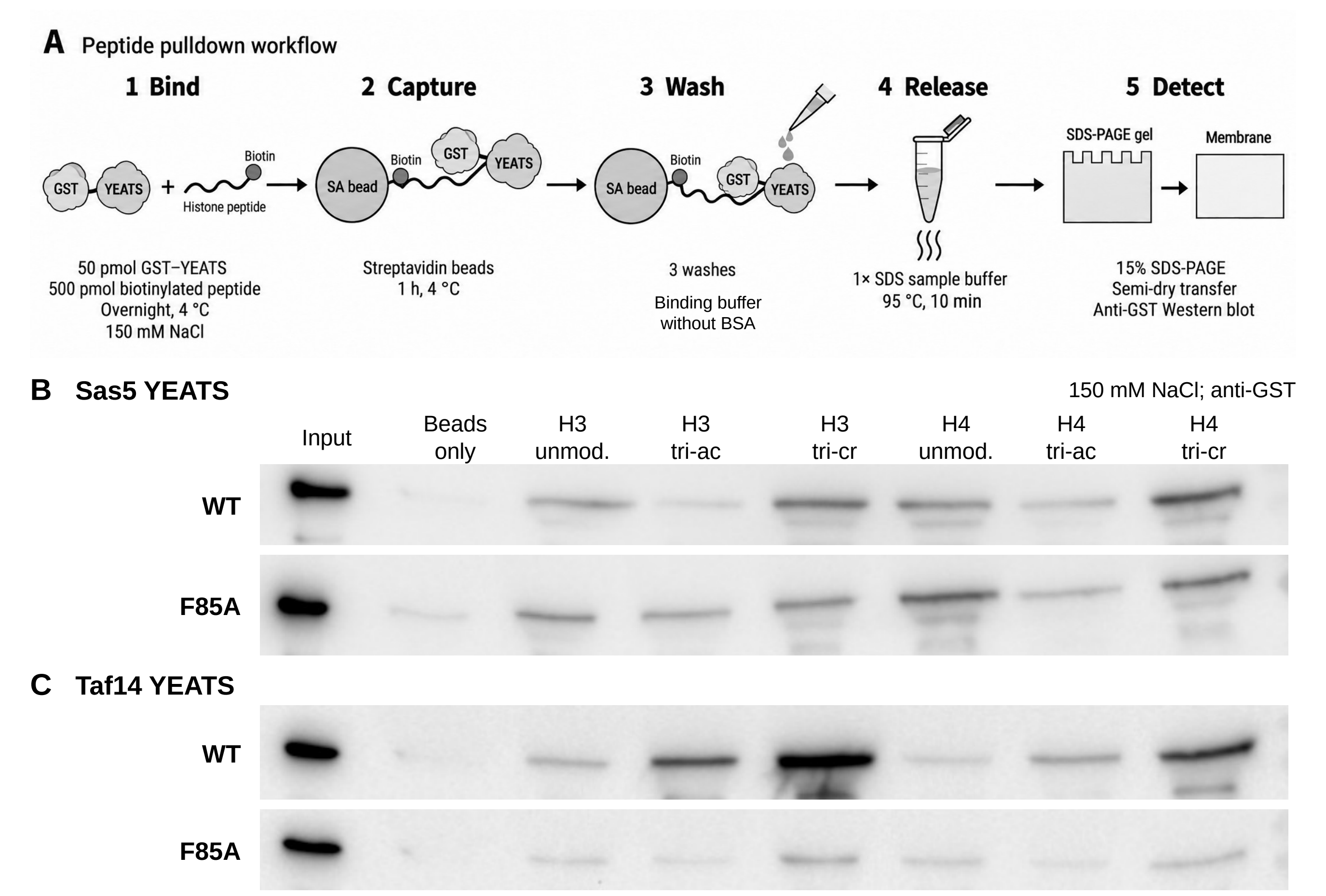
My mentor, Kit Cummins, and I picked a conserved aromatic residue in the YEATS pocket, phenylalanine 85, and asked whether changing it to alanine (F85A) would break binding. I expressed the YEATS domains of Sas5 and of Taf14, a related yeast reader known to prefer acylated tails, in E. coli as GST fusions, purified them, and quantified them from Coomassie gels so equal amounts could be compared. I then designed and ran histone peptide pulldowns against unmodified, acetylated and crotonylated H3 and H4 tails, read out by immunoblot, with input and beads-only controls. Kit designed and ran the cellular experiments, measuring H4K16ac and the Sas4 subunit in yeast strains lacking Sas5, lacking only its YEATS domain, or carrying F85A; I interpreted those blots for the thesis.

A.3

What I’m learning

My starting hypothesis was that F85A would weaken Sas5 binding and mimic losing the whole domain. That is not what happened.

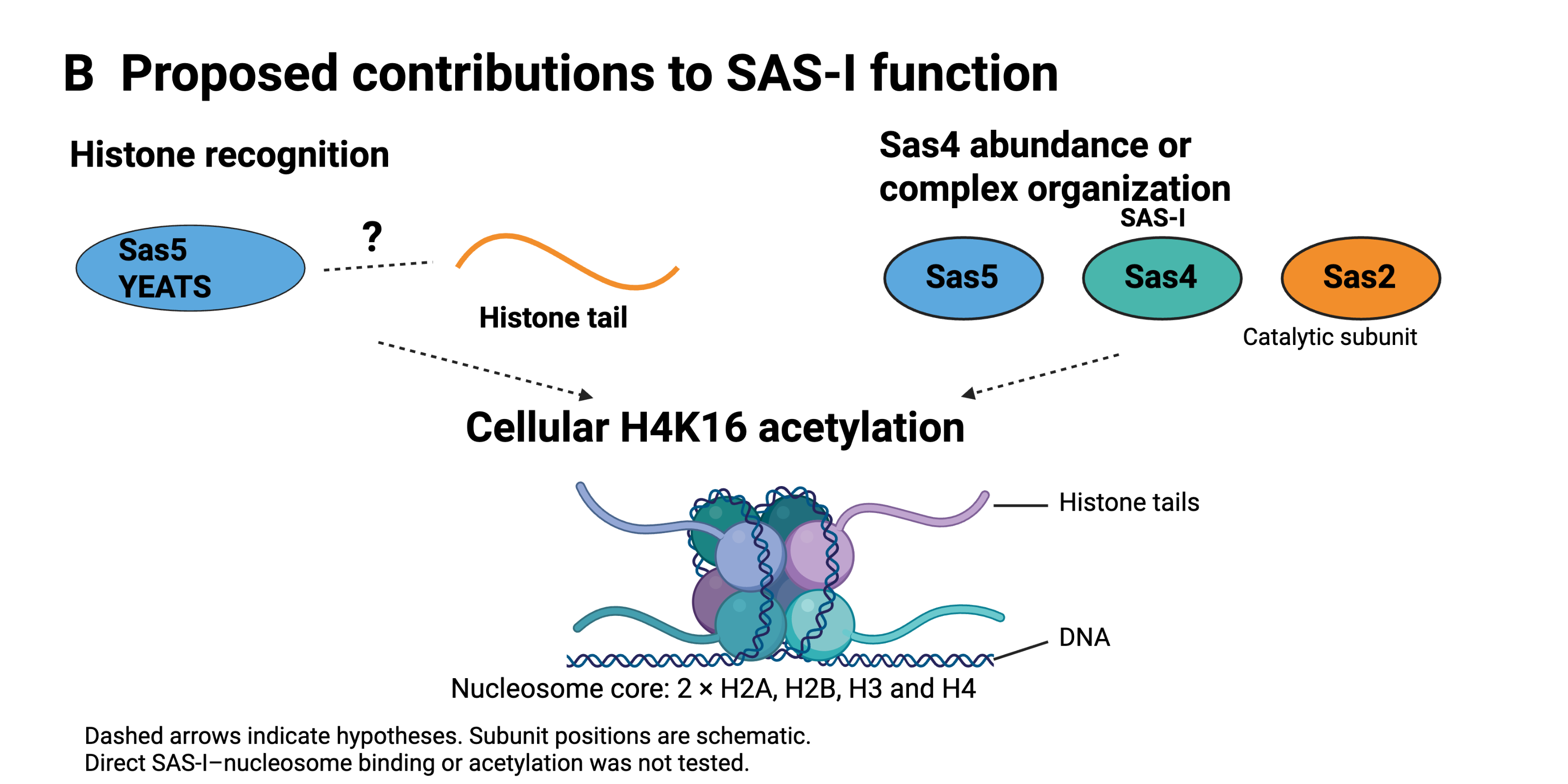
Sas5 F85A still bound every peptide we tested, while the same change weakened Taf14 across the panel; the pattern held in three assays on separate days. Sas5 also showed no preference for acetylated tails, and its binding dropped sharply at higher salt, which hints that it partly depends on charge contacts rather than reading a specific mark. In Kit's cellular data, removing Sas5 or just its YEATS domain lowered H4K16ac and made Sas4 nearly undetectable, while F85A left H4K16ac close to normal. Taken together, the domain seems to support SAS-I mainly by keeping the complex intact, not only by recognizing a mark. Why Sas4 drops is still unresolved.

The limits are real: these were qualitative pulldowns with isolated domains, not the full complex or nucleosomes, and repeats used shared protein stocks rather than independent preparations.

Workflow diagram of a five-step peptide pulldown (bind, capture, wash, release, detect) above immunoblots. Sas5 wild-type and F85A rows show bands for all six H3 and H4 peptides. Taf14 wild-type shows strong bands for acylated peptides; the Taf14 F85A row is faint throughout.
Fig. A1 Peptide pulldowns with purified YEATS domains. (A) Workflow. (B) Sas5: wild type and F85A both bind every histone tail tested. (C) Taf14: F85A weakens binding across the panel. Anti-GST immunoblots, 150 mM NaCl; representative of three assays.
Schematic. Left, Sas5 YEATS beside a histone tail with a question mark. Right, the three SAS-I subunits Sas5, Sas4 and Sas2. Dashed arrows from both lead to "Cellular H4K16 acetylation" above a drawing of a nucleosome.
Fig. A2 Two non-exclusive ways Sas5 could support H4K16 acetylation: recognizing histone tails, or maintaining Sas4 and the SAS-I complex. Dashed arrows are hypotheses; this work favors the second.
A.4

Open questions

How does the YEATS domain keep Sas4 around: does it help the complex assemble, or protect Sas4 from turnover? How much of Sas5's binding depends on its pocket at all, measured quantitatively and with other pocket mutants? And does Sas5 behave differently on whole nucleosomes than on free tail peptides? This thesis is one piece of a larger, ongoing Strahl Lab project on how SAS-I engages chromatin.

Materials

Filed here once they exist.

SlidesSlot empty
Posters

"Defining the Role of the Sas5 YEATS Domain in Histone Acetylation and Chromatin-State Regulation." Wang R, Cummins C, Strahl BD. 27th Annual Celebration of Undergraduate Research, UNC, Apr 2026.

Download PDF ↓
Papers

"How Does Sas5 Recognize Histone Proteins?" SURF public research summary, Carolina Digital Repository, Aug 2026.

doi.org/10.17615/vt8g-1h07 ↗